In engineering and science, dimensional analysis is the analysis of the relationships between different physical quantities by identifying their base quantities (such as length, mass, time, and electric current) and units of measure (such as miles vs. kilometres, or pounds vs. kilograms) and tracking these dimensions as calculations or comparisons are performed. The conversion of units from one dimensional unit to another is often easier within the metric or SI system than in others, due to the regular 10-base in all units. Dimensional analysis, or more specifically the factor-label method, also known as the unit-factor method, is a widely used technique for such conversions using the rules of algebra.[1][2][3]
Commensurable physical quantities are of the same kind and have the same dimension, and can be directly compared to each other, even if they are originally expressed in differing units of measure, e.g. yards and metres, pounds (mass) and kilograms, seconds and years. Incommensurable physical quantities are of different kinds and have different dimensions, and can not be directly compared to each other, no matter what units they are originally expressed in, e.g. meters and kilograms, seconds and kilograms, meters and seconds. For example, asking whether a kilogram is larger than an hour is meaningless.
Any physically meaningful equation, or inequality, must have the same dimensions on its left and right sides, a property known as dimensional homogeneity. Checking for dimensional homogeneity is a common application of dimensional analysis, serving as a plausibility check on derived equations and computations. It also serves as a guide and constraint in deriving equations that may describe a physical system in the absence of a more rigorous derivation.
The concept of physical dimension, and of dimensional analysis, was introduced by Joseph Fourier in 1822.[4]
Concrete numbers and base units
Many parameters and measurements in the physical sciences and engineering are expressed as a concrete number—a numerical quantity and a corresponding dimensional unit. Often a quantity is expressed in terms of several other quantities; for example, speed is a combination of length and time, e.g. 60 kilometres per hour or 1.4 kilometres per second. Compound relations with "per" are expressed with division, e.g. 60 km/1 h. Other relations can involve multiplication (often shown with a centered dot or juxtaposition), powers (like m2 for square metres), or combinations thereof.
A set of base units for a system of measurement is a conventionally chosen set of units, none of which can be expressed as a combination of the others and in terms of which all the remaining units of the system can be expressed.[5] For example, units for length and time are normally chosen as base units. Units for volume, however, can be factored into the base units of length (m3), thus they are considered derived or compound units.
Sometimes the names of units obscure the fact that they are derived units. For example, a newton (N) is a unit of force, which has units of mass (kg) times units of acceleration (m⋅s−2). The newton is defined as 1 N = 1 kg⋅m⋅s−2.
Percentages, derivatives and integrals
Percentages are dimensionless quantities, since they are ratios of two quantities with the same dimensions. In other words, the % sign can be read as "hundredths", since 1% = 1/100.
Taking a derivative with respect to a quantity adds the dimension of the variable one is differentiating with respect to, in the denominator. Thus:
- position (x) has the dimension L (length);
- derivative of position with respect to time (dx/dt, velocity) has dimension T−1L—length from position, time due to the gradient;
- the second derivative (d2x/dt2 = d(dx/dt) / dt, acceleration) has dimension T−2L.
Likewise, taking an integral adds the dimension of the variable one is integrating with respect to, but in the numerator.
- force has the dimension T−2LM (mass multiplied by acceleration);
- the integral of force with respect to the distance (s) the object has travelled (
, work) has dimension T−2L2M.
In economics, one distinguishes between stocks and flows: a stock has units of "units" (say, widgets or dollars), while a flow is a derivative of a stock, and has units of "units/time" (say, dollars/year).
In some contexts, dimensional quantities are expressed as dimensionless quantities or percentages by omitting some dimensions. For example, debt-to-GDP ratios are generally expressed as percentages: total debt outstanding (dimension of currency) divided by annual GDP (dimension of currency)—but one may argue that, in comparing a stock to a flow, annual GDP should have dimensions of currency/time (dollars/year, for instance) and thus debt-to-GDP should have units of years, which indicates that debt-to-GDP is the number of years needed for a constant GDP to pay the debt, if all GDP is spent on the debt and the debt is otherwise unchanged.
Conversion factor
In dimensional analysis, a ratio which converts one unit of measure into another without changing the quantity is called a conversion factor. For example, kPa and bar are both units of pressure, and 100 kPa = 1 bar. The rules of algebra allow both sides of an equation to be divided by the same expression, so this is equivalent to 100 kPa / 1 bar = 1. Since any quantity can be multiplied by 1 without changing it, the expression "100 kPa / 1 bar" can be used to convert from bars to kPa by multiplying it with the quantity to be converted, including units. For example, 5 bar × 100 kPa / 1 bar = 500 kPa because 5 × 100 / 1 = 500, and bar/bar cancels out, so 5 bar = 500 kPa.
Dimensional homogeneity
The most basic rule of dimensional analysis is that of dimensional homogeneity.[6]
However, the dimensions form an abelian group under multiplication, so:
For example, it makes no sense to ask whether 1 hour is more, the same, or less than 1 kilometre, as these have different dimensions, nor to add 1 hour to 1 kilometre. However, it makes perfect sense to ask whether 1 mile is more, the same, or less than 1 kilometre being the same dimension of physical quantity even though the units are different. On the other hand, if an object travels 100 km in 2 hours, one may divide these and conclude that the object's average speed was 50 km/h.
The rule implies that in a physically meaningful expression only quantities of the same dimension can be added, subtracted, or compared. For example, if mman, mrat and Lman denote, respectively, the mass of some man, the mass of a rat and the length of that man, the dimensionally homogeneous expression mman + mrat is meaningful, but the heterogeneous expression mman + Lman is meaningless. However, mman/L2man is fine. Thus, dimensional analysis may be used as a sanity check of physical equations: the two sides of any equation must be commensurable or have the same dimensions.
This has the implication that most mathematical functions, particularly the transcendental functions, must have a dimensionless quantity, a pure number, as the argument and must return a dimensionless number as a result. This is clear because many transcendental functions can be expressed as an infinite power series with dimensionless coefficients.

All powers of x must have the same dimension for the terms to be commensurable. But if x is not dimensionless, then the different powers of x will have different, incommensurable dimensions. However, power functions including root functions may have a dimensional argument and will return a result having dimension that is the same power applied to the argument dimension. This is because power functions and root functions are, loosely, just an expression of multiplication of quantities.
Even when two physical quantities have identical dimensions, it may nevertheless be meaningless to compare or add them. For example, although torque and energy share the dimension T−2L2M, they are fundamentally different physical quantities.
To compare, add, or subtract quantities with the same dimensions but expressed in different units, the standard procedure is first to convert them all to the same units. For example, to compare 32 metres with 35 yards, use 1 yard = 0.9144 m to convert 35 yards to 32.004 m.
A related principle is that any physical law that accurately describes the real world must be independent of the units used to measure the physical variables.[7] For example, Newton's laws of motion must hold true whether distance is measured in miles or kilometres. This principle gives rise to the form that conversion factors must take between units that measure the same dimension: multiplication by a simple constant. It also ensures equivalence; for example, if two buildings are the same height in feet, then they must be the same height in metres.
The factor-label method for converting units
The factor-label method is the sequential application of conversion factors expressed as fractions and arranged so that any dimensional unit appearing in both the numerator and denominator of any of the fractions can be cancelled out until only the desired set of dimensional units is obtained. For example, 10 miles per hour can be converted to meters per second by using a sequence of conversion factors as shown below:

Each conversion factor is chosen based on the relationship between one of the original units and one of the desired units (or some intermediary unit), before being re-arranged to create a factor that cancels out the original unit. For example, as "mile" is the numerator in the original fraction and 
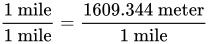
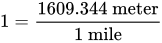
As a more complex example, the concentration of nitrogen oxides (i.e., 

- NOx concentration
- = 10 parts per million by volume = 10 ppmv = 10 volumes/106 volumes
- NOx molar mass
- = 46 kg/kmol = 46 g/mol
- Flow rate of flue gas
- = 20 cubic meters per minute = 20 m3/min
- The flue gas exits the furnace at 0 °C temperature and 101.325 kPa absolute pressure.
- The molar volume of a gas at 0 °C temperature and 101.325 kPa is 22.414 m3/kmol.

After canceling out any dimensional units that appear both in the numerators and denominators of the fractions in the above equation, the NOx concentration of 10 ppmv converts to mass flow rate of 24.63 grams per hour.
Checking equations that involve dimensions
The factor-label method can also be used on any mathematical equation to check whether or not the dimensional units on the left hand side of the equation are the same as the dimensional units on the right hand side of the equation. Having the same units on both sides of an equation does not ensure that the equation is correct, but having different units on the two sides (when expressed in terms of base units) of an equation implies that the equation is wrong.
For example, check the Universal Gas Law equation of PV = nRT, when:
- the pressure P is in pascals (Pa)
- the volume V is in cubic meters (m3)
- the amount of substance n is in moles (mol)
- the universal gas law constant R is 8.3145 Pa⋅m3/(mol⋅K)
- the temperature T is in kelvins (K)
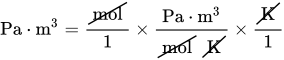
As can be seen, when the dimensional units appearing in the numerator and denominator of the equation's right hand side are cancelled out, both sides of the equation have the same dimensional units. Dimensional analysis can be used as a tool to construct equations that relate non-associated physico-chemical properties. The equations may reveal hitherto unknown or overlooked properties of matter, in the form of left-over dimensions – dimensional adjusters – that can then be assigned physical significance. It is important to point out that such 'mathematical manipulation' is neither without prior precedent, nor without considerable scientific significance. Indeed, the Planck constant, a fundamental constant of the universe, was 'discovered' as a purely mathematical abstraction or representation that built on the Rayleigh–Jeans law for preventing the ultraviolet catastrophe. It was assigned and ascended to its quantum physical significance either in tandem or post mathematical dimensional adjustment – not earlier.
Limitations
The factor-label method can convert only unit quantities for which the units are in a linear relationship intersecting at 0. (Ratio scale in Stevens's typology) Most units fit this paradigm. An example for which it cannot be used is the conversion between degrees Celsius and kelvins (or degrees Fahrenheit). Between degrees Celsius and kelvins, there is a constant difference rather than a constant ratio, while between degrees Celsius and degrees Fahrenheit there is neither a constant difference nor a constant ratio. There is, however, an affine transform (

For example, the freezing point of water is 0 °C and 32 °F, and a 5 °C change is the same as a 9 °F change. Thus, to convert from units of Fahrenheit to units of Celsius, one subtracts 32 °F (the offset from the point of reference), divides by 9 °F and multiplies by 5 °C (scales by the ratio of units), and adds 0 °C (the offset from the point of reference). Reversing this yields the formula for obtaining a quantity in units of Celsius from units of Fahrenheit; one could have started with the equivalence between 100 °C and 212 °F, though this would yield the same formula at the end.
Hence, to convert the numerical quantity value of a temperature T[F] in degrees Fahrenheit to a numerical quantity value T[C] in degrees Celsius, this formula may be used:
- T[C] = (T[F] − 32) × 5/9.
To convert T[C] in degrees Celsius to T[F] in degrees Fahrenheit, this formula may be used:
- T[F] = (T[C] × 9/5) + 32.
Applications
Dimensional analysis is most often used in physics and chemistry – and in the mathematics thereof – but finds some applications outside of those fields as well.
Mathematics
A simple application of dimensional analysis to mathematics is in computing the form of the volume of an n-ball (the solid ball in n dimensions), or the area of its surface, the n-sphere: being an n-dimensional figure, the volume scales as 


Finance, economics, and accounting
In finance, economics, and accounting, dimensional analysis is most commonly referred to in terms of the distinction between stocks and flows. More generally, dimensional analysis is used in interpreting various financial ratios, economics ratios, and accounting ratios.
- For example, the P/E ratio has dimensions of time (units of years), and can be interpreted as "years of earnings to earn the price paid".
- In economics, debt-to-GDP ratio also has units of years (debt has units of currency, GDP has units of currency/year).
- Velocity of money has units of 1/years (GDP/money supply has units of currency/year over currency): how often a unit of currency circulates per year.
- Annual continuously compounded interest rates and simple interest rates are often expressed as a percentage (adimensional quantity) while time is expressed as an adimensional quantity consisting of the number of years. However, if the time includes year as the unit of measure, the dimension of the rate is 1/year. Of course, there is nothing special (apart from the usual convention) about using year as a unit of time: any other time unit can be used. Furthermore, if rate and time include their units of measure the use of different units for each is not problematic. In contrast, rate and time need to refer to a common period if they are adimensional. (Note that effective interest rates can only be defined as adimensional quantities.)
- In financial analysis, bond duration can be defined as (dV/dr)/V, where V is the value of a bond (or portfolio), r is the continuously compounded interest rate and dV/dr is a derivative. From the previous point, the dimension of r is 1/time. Therefore, the dimension of duration is time (usually expressed in years) because dr is in the "denominator" of the derivative.
Fluid mechanics
In fluid mechanics, dimensional analysis is performed to obtain dimensionless pi terms or groups. According to the principles of dimensional analysis, any prototype can be described by a series of these terms or groups that describe the behaviour of the system. Using suitable pi terms or groups, it is possible to develop a similar set of pi terms for a model that has the same dimensional relationships.[8] In other words, pi terms provide a shortcut to developing a model representing a certain prototype. Common dimensionless groups in fluid mechanics include:
- Reynolds number (Re), generally important in all types of fluid problems:
- Froude number (Fr), modeling flow with a free surface:
- Euler number (Eu), used in problems in which pressure is of interest:
- Mach number (Ma), important in high speed flows where the velocity approaches or exceeds the local speed of sound:where c is the local speed of sound.


History
The origins of dimensional analysis have been disputed by historians.[9][10]
The first written application of dimensional analysis has been credited to an article of François Daviet at the Turin Academy of Science. Daviet had the master Lagrange as teacher. His fundamental works are contained in acta of the Academy dated 1799.[10]
This led to the conclusion that meaningful laws must be homogeneous equations in their various units of measurement, a result which was eventually later formalized in the Buckingham π theorem. Simeon Poisson also treated the same problem of the parallelogram law by Daviet, in his treatise of 1811 and 1833 (vol I, p. 39).[11] In the second edition of 1833, Poisson explicitly introduces the term dimension instead of the Daviet homogeneity.
In 1822, the important Napoleonic scientist Joseph Fourier made the first credited important contributions[12] based on the idea that physical laws like F = ma should be independent of the units employed to measure the physical variables.
James Clerk Maxwell played a major role in establishing modern use of dimensional analysis by distinguishing mass, length, and time as fundamental units, while referring to other units as derived.[13] Although Maxwell defined length, time and mass to be "the three fundamental units", he also noted that gravitational mass can be derived from length and time by assuming a form of Newton's law of universal gravitation in which the gravitational constant G is taken as unity, thereby defining M = T−2L3.[14] By assuming a form of Coulomb's law in which Coulomb's constant ke is taken as unity, Maxwell then determined that the dimensions of an electrostatic unit of charge were Q = T−1L3/2M1/2,[15] which, after substituting his M = T−2L3 equation for mass, results in charge having the same dimensions as mass, viz. Q = T−2L3.
Dimensional analysis is also used to derive relationships between the physical quantities that are involved in a particular phenomenon that one wishes to understand and characterize. It was used for the first time (Pesic 2005) in this way in 1872 by Lord Rayleigh, who was trying to understand why the sky is blue. Rayleigh first published the technique in his 1877 book The Theory of Sound.[16]
The original meaning of the word dimension, in Fourier's Theorie de la Chaleur, was the numerical value of the exponents of the base units. For example, acceleration was considered to have the dimension 1 with respect to the unit of length, and the dimension −2 with respect to the unit of time.[17] This was slightly changed by Maxwell, who said the dimensions of acceleration are T−2L, instead of just the exponents.[18]