Contact mechanics is the study of the deformation of solids that touch each other at one or more points.[1][2] A central distinction in contact mechanics is between stresses acting perpendicular to the contacting bodies' surfaces (known as the normal direction) and frictional stresses acting tangentially between the surfaces. This page focuses mainly on the normal direction, i.e. on frictionless contact mechanics. Frictional contact mechanics is discussed separately. Normal stresses are caused by applied forces and by the adhesion present on surfaces in close contact even if they are clean and dry.

Contact mechanics is part of mechanical engineering. The physical and mathematical formulation of the subject is built upon the mechanics of materials and continuum mechanics and focuses on computations involving elastic, viscoelastic, and plastic bodies in static or dynamic contact. Contact mechanics provides necessary information for the safe and energy efficient design of technical systems and for the study of tribology, contact stiffness, electrical contact resistance and indentation hardness. Principles of contacts mechanics are implemented towards applications such as locomotive wheel-rail contact, coupling devices, braking systems, tires, bearings, combustion engines, mechanical linkages, gasket seals, metalworking, metal forming, ultrasonic welding, electrical contacts, and many others. Current challenges faced in the field may include stress analysis of contact and coupling members and the influence of lubrication and material design on friction and wear. Applications of contact mechanics further extend into the micro- and nanotechnological realm.
The original work in contact mechanics dates back to 1881 with the publication of the paper "On the contact of elastic solids"[3] ("Ueber die Berührung fester elastischer Körper") by Heinrich Hertz. Hertz was attempting to understand how the optical properties of multiple, stacked lenses might change with the force holding them together. Hertzian contact stress refers to the localized stresses that develop as two curved surfaces come in contact and deform slightly under the imposed loads. This amount of deformation is dependent on the modulus of elasticity of the material in contact. It gives the contact stress as a function of the normal contact force, the radii of curvature of both bodies and the modulus of elasticity of both bodies. Hertzian contact stress forms the foundation for the equations for load bearing capabilities and fatigue life in bearings, gears, and any other bodies where two surfaces are in contact.
History
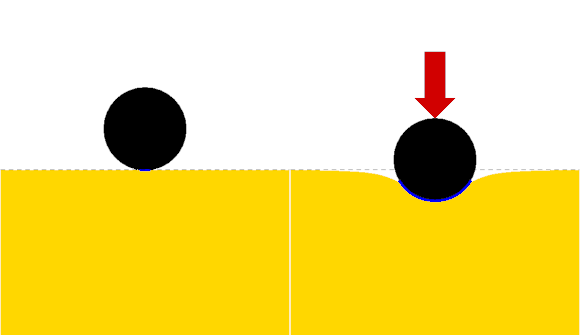
Classical contact mechanics is most notably associated with Heinrich Hertz.[3][4] In 1882, Hertz solved the contact problem of two elastic bodies with curved surfaces. This still-relevant classical solution provides a foundation for modern problems in contact mechanics. For example, in mechanical engineering and tribology, Hertzian contact stress is a description of the stress within mating parts. The Hertzian contact stress usually refers to the stress close to the area of contact between two spheres of different radii.
It was not until nearly one hundred years later that Johnson, Kendall, and Roberts found a similar solution for the case of adhesive contact.[5] This theory was rejected by Boris Derjaguin and co-workers[6] who proposed a different theory of adhesion[7] in the 1970s. The Derjaguin model came to be known as the DMT (after Derjaguin, Muller and Toporov) model,[7] and the Johnson et al. model came to be known as the JKR (after Johnson, Kendall and Roberts) model for adhesive elastic contact. This rejection proved to be instrumental in the development of the Tabor[8] and later Maugis[6][9] parameters that quantify which contact model (of the JKR and DMT models) represent adhesive contact better for specific materials.
Further advancement in the field of contact mechanics in the mid-twentieth century may be attributed to names such as Bowden and Tabor. Bowden and Tabor were the first to emphasize the importance of surface roughness for bodies in contact.[10][11] Through investigation of the surface roughness, the true contact area between friction partners is found to be less than the apparent contact area. Such understanding also drastically changed the direction of undertakings in tribology. The works of Bowden and Tabor yielded several theories in contact mechanics of rough surfaces.
The contributions of Archard (1957)[12] must also be mentioned in discussion of pioneering works in this field. Archard concluded that, even for rough elastic surfaces, the contact area is approximately proportional to the normal force. Further important insights along these lines were provided by Greenwood and Williamson (1966),[13] Bush (1975),[14] and Persson (2002).[15] The main findings of these works were that the true contact surface in rough materials is generally proportional to the normal force, while the parameters of individual micro-contacts (i.e., pressure, size of the micro-contact) are only weakly dependent upon the load.
Classical solutions for non-adhesive elastic contact
The theory of contact between elastic bodies can be used to find contact areas and indentation depths for simple geometries. Some commonly used solutions are listed below. The theory used to compute these solutions is discussed later in the article. Solutions for multitude of other technically relevant shapes, e.g. the truncated cone, the worn sphere, rough profiles, hollow cylinders, etc. can be found in [16]
Contact between a sphere and a half-space
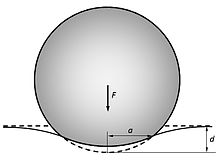
An elastic sphere of radius 


The applied force 
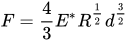
where
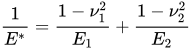
and 


The distribution of normal pressure in the contact area as a function of distance from the center of the circle is[1]
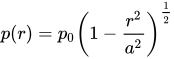
where 
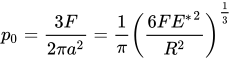
The radius of the circle is related to the applied load

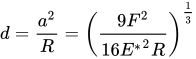
The total deformation
The maximum shear stress occurs in the interior at 

Contact between two spheres


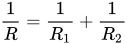
For contact between two spheres of radii 


Contact between two crossed cylinders of equal radius
This is equivalent to contact between a sphere of radius
Contact between a rigid cylinder with flat end and an elastic half-space

If a rigid cylinder is pressed into an elastic half-space, it creates a pressure distribution described by[17]
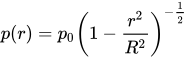
where
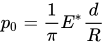
The relationship between the indentation depth and the normal force is given by

Contact between a rigid conical indenter and an elastic half-space

In the case of indentation of an elastic half-space of Young's modulus 


with 

The total force is

The pressure distribution is given by

The stress has a logarithmic singularity at the tip of the cone.
Contact between two cylinders with parallel axes

In contact between two cylinders with parallel axes, the force is linearly proportional to the length of cylinders L and to the indentation depth d:[18]
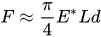
The radii of curvature are entirely absent from this relationship. The contact radius is described through the usual relationship
with
as in contact between two spheres. The maximum pressure is equal to
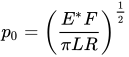
Bearing contact
The contact in the case of bearings is often a contact between a convex surface (male cylinder or sphere) and a concave surface (female cylinder or sphere: bore or hemispherical cup).
The Method of Dimensionality Reduction

Some contact problems can be solved with the Method of Dimensionality Reduction (MDR). In this method, the initial three-dimensional system is replaced with a contact of a body with a linear elastic or viscoelastic foundation (see fig.). The properties of one-dimensional systems coincide exactly with those of the original three-dimensional system, if the form of the bodies is modified and the elements of the foundation are defined according to the rules of the MDR.[19][20] MDR is based on the solution to axisymmetric contact problems first obtained by Ludwig Föppl (1941) and Gerhard Schubert (1942)[21]
However, for exact analytical results, it is required that the contact problem is axisymmetric and the contacts are compact.
Hertzian theory of non-adhesive elastic contact
The classical theory of contact focused primarily on non-adhesive contact where no tension force is allowed to occur within the contact area, i.e., contacting bodies can be separated without adhesion forces. Several analytical and numerical approaches have been used to solve contact problems that satisfy the no-adhesion condition. Complex forces and moments are transmitted between the bodies where they touch, so problems in contact mechanics can become quite sophisticated. In addition, the contact stresses are usually a nonlinear function of the deformation. To simplify the solution procedure, a frame of reference is usually defined in which the objects (possibly in motion relative to one another) are static. They interact through surface tractions (or pressures/stresses) at their interface.
As an example, consider two objects which meet at some surface in the ( , )-plane with the -axis assumed normal to the surface. One of the bodies will experience a normally-directed pressure distribution 
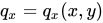
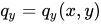


must be equal and opposite to the forces established in the other body. The moments corresponding to these forces:
![{\displaystyle M_{x}=\int _{S}y~q_{z}(x,y)~\mathrm {d} A~;~~M_{y}=\int _{S}-x~q_{z}(x,y)~\mathrm {d} A~;~~M_{z}=\int _{S}[x~q_{y}(x,y)-y~q_{x}(x,y)]~\mathrm {d} A}](https://wikimedia.org/api/rest_v1/media/math/render/svg/84858a589cb089aa631e81fb379d152b42ab368b)
are also required to cancel between bodies so that they are kinematically immobile.
Assumptions in Hertzian theory
The following assumptions are made in determining the solutions of Hertzian contact problems:
- The strains are small and within the elastic limit.
- The surfaces are continuous and non-conforming (implying that the area of contact is much smaller than the characteristic dimensions of the contacting bodies).
- Each body can be considered an elastic half-space.
- The surfaces are frictionless.
Additional complications arise when some or all these assumptions are violated and such contact problems are usually called non-Hertzian.
Analytical solution techniques

Analytical solution methods for non-adhesive contact problem can be classified into two types based on the geometry of the area of contact.[22] A conforming contact is one in which the two bodies touch at multiple points before any deformation takes place (i.e., they just "fit together"). A non-conforming contact is one in which the shapes of the bodies are dissimilar enough that, under zero load, they only touch at a point (or possibly along a line). In the non-conforming case, the contact area is small compared to the sizes of the objects and the stresses are highly concentrated in this area. Such a contact is called concentrated, otherwise it is called diversified.
A common approach in linear elasticity is to superpose a number of solutions each of which corresponds to a point load acting over the area of contact. For example, in the case of loading of a half-plane, the Flamant solution is often used as a starting point and then generalized to various shapes of the area of contact. The force and moment balances between the two bodies in contact act as additional constraints to the solution.
Point contact on a (2D) half-plane

A starting point for solving contact problems is to understand the effect of a "point-load" applied to an isotropic, homogeneous, and linear elastic half-plane, shown in the figure to the right. The problem may be either plane stress or plane strain. This is a boundary value problem of linear elasticity subject to the traction boundary conditions:

where 
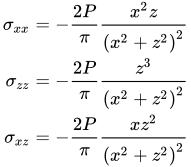
for some point, 
Line contact on a (2D) half-plane
Normal loading over a region 
Suppose, rather than a point load 


![{\displaystyle {\begin{aligned}\sigma _{xx}&=-{\frac {2z}{\pi }}\int _{a}^{b}{\frac {p\left(x'\right)\left(x-x'\right)^{2}\,dx'}{\left[\left(x-x'\right)^{2}+z^{2}\right]^{2}}}~;~~\sigma _{zz}=-{\frac {2z^{3}}{\pi }}\int _{a}^{b}{\frac {p\left(x'\right)\,dx'}{\left[\left(x-x'\right)^{2}+z^{2}\right]^{2}}}\\[3pt]\sigma _{xz}&=-{\frac {2z^{2}}{\pi }}\int _{a}^{b}{\frac {p\left(x'\right)\left(x-x'\right)\,dx'}{\left[\left(x-x'\right)^{2}+z^{2}\right]^{2}}}\end{aligned}}}](https://wikimedia.org/api/rest_v1/media/math/render/svg/748f49fbb04908de77b05ca997ec1baefdc73491)
Shear loading over a region
The same principle applies for loading on the surface in the plane of the surface. These kinds of tractions would tend to arise as a result of friction. The solution is similar the above (for both singular loads 

![{\displaystyle {\begin{aligned}\sigma _{xx}&=-{\frac {2}{\pi }}\int _{a}^{b}{\frac {q\left(x'\right)\left(x-x'\right)^{3}\,dx'}{\left[\left(x-x'\right)^{2}+z^{2}\right]^{2}}}~;~~\sigma _{zz}=-{\frac {2z^{2}}{\pi }}\int _{a}^{b}{\frac {q\left(x'\right)\left(x-x'\right)\,dx'}{\left[\left(x-x'\right)^{2}+z^{2}\right]^{2}}}\\[3pt]\sigma _{xz}&=-{\frac {2z}{\pi }}\int _{a}^{b}{\frac {q\left(x'\right)\left(x-x'\right)^{2}\,dx'}{\left[\left(x-x'\right)^{2}+z^{2}\right]^{2}}}\end{aligned}}}](https://wikimedia.org/api/rest_v1/media/math/render/svg/c3d99b5917ad56c9a691709199164f1bd9018c3f)
These results may themselves be superposed onto those given above for normal loading to deal with more complex loads.
Point contact on a (3D) half-space
Analogously to the Flamant solution for the 2D half-plane, fundamental solutions are known for the linearly elastic 3D half-space as well. These were found by Boussinesq for a concentrated normal load and by Cerruti for a tangential load. See the section on this in Linear elasticity.
Numerical solution techniques
Distinctions between conforming and non-conforming contact do not have to be made when numerical solution schemes are employed to solve contact problems. These methods do not rely on further assumptions within the solution process since they base solely on the general formulation of the underlying equations.[23][24][25][26][27] Besides the standard equations describing the deformation and motion of bodies two additional inequalities can be formulated. The first simply restricts the motion and deformation of the bodies by the assumption that no penetration can occur. Hence the gap 

where 

At locations where there is contact between the surfaces the gap is zero, i.e. 



These conditions are valid in a general way. The mathematical formulation of the gap depends upon the kinematics of the underlying theory of the solid (e.g., linear or nonlinear solid in two- or three dimensions, beam or shell model). By restating the normal stress 




 is the rigid body separation,
  is the geometry/topography of the contact (cylinder and roughness) and
  is the elastic deformation/deflection. If the contacting bodies are approximated as linear elastic half spaces, the Boussinesq-Cerruti integral equation solution can be applied to express the deformation () as a function of the contact pressure (); i.e.,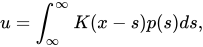


After discretization the linear elastic contact mechanics problem can be stated in standard Linear Complementarity Problem (LCP) form.[28]
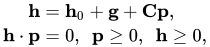
where 